What this application does:
This application queries OpenAlex for information about publications submitted in a DOI file. It then returns text versions of the information retrieved and visualizations comparing the publications in aggregate. Specifically it uses the OpenAlex Work object, parsing JSON files for each publication queried.
See the "How to use this app" and "Example usage" pages for more information.
A note on usage and limitations:
Some errors in OpenAlex metadata have been observed. If OpenAlex metadata is inaccurate or missing, the visualizations and text returned by the Computable Bibliography will also be inaccurate. Further, only publications with a valid DOI generate results, which excludes many types of academic works.
Upload a DOI file:
Input data
Query OpenAlex
Query result dictionaries
Identifiers with errors:
Results for identifiers without errors:
Plots
How to use the Computable Bibliography
What this application does:
This application queries OpenAlex for information about publications submitted in a DOI file, which is described below. It then returns text versions of the information retrieved and visualizations comparing the publications in aggregate. Specifically it uses the OpenAlex Work object, parsing JSON files for each publication queried.
A note on usage and limitations:
Some errors in OpenAlex metadata have been observed. If OpenAlex metadata is inaccurate or missing, the visualizations and text returned by the Computable Bibliography will also be inaccurate. Further, only publications with a valid DOI generate results, which excludes many types of academic works.
See below for examples of metadata problems. See the "Example usage" tab for sample outputs.
How to use this application:
1. Create a DOI file, which is a text file (.txt file) of Digital Object Identifiers (DOIs) for all publications you would like to compare.
Formatting guidelines:
- One DOI per line in the text (.txt) file.
- DOIs can be in any of the following formats:
- https://doi.org/10.XXX/XXXX
- doi:10.XXXX/XXXX
- 10.XXXX/XXXX
- The app will ignore blank/empty lines.
Examples:
- Download an example DOI file.
- Visually, a DOI file might look like:
    https://doi.org/10.1056/NEJMc2004973
    10.1034/j.1600-0668.2002.01145.x
    10.1111/j.1539-6924.2010.01427.x
    doi:10.3201/eid2608.200681
    10.1073/pnas.2005615117
    10.1038/s41569-020-0360-5
    https://doi.org/10.1073/pnas.1716771115
    10.1016/j.envint.2020.105537
Tips:
In a citation manager such as Zotero, you can create a DOI file by:
- Exporting a library or collection to .csv format.
- Copying the DOI column of the .csv file.
- Pasting the DOI column into a text editor such as Notepad (Windows) or TextEdit (Mac).
- Saving the resulting text file. Blank lines do not need to be removed.
You can also manually copy and paste DOIs into a text file using text editor such as Notepad (Windows) or TextEdit (Mac).
2. On the Computable Bibliography webpage, click "Browse..." and select the DOI file you created.
Functionality for files other than text (.txt) is forthcoming.
3. Review information listed under "Input data".
This will show cleaned and standardized versions of the DOIs you submitted.
4. Hit the button "Query OpenAlex"
This will query the OpenAlex API for each DOI you submit. Large requests can take some time.
5. View results
After the "Computing, please wait..." message is gone, scroll down to see the results. You will be able to copy the identifiers that had errors when querying OpenAlex and the Python dictionaries used to create visualizations shown. Code to create the visualizations is available via the Information Quality Lab GitHub
Examples of inaccurate OpenAlex metadata
- Publication https://doi.org/10.18653/v1/P18-1017
- OpenAlex lists the publication's primary location as "Proceedings of the 60th Annual Meeting of the Association for Computational Linguistics (Volume 1: Long Papers)". Querying "https://api.openalex.org/works/https://doi.org/10.18653/v1/P18-1017"
- Actual primary location (from following DOI) is "Proceedings of the 56th Annual Meeting of the Association for Computational Linguistics (Volume 1: Long Papers)"
- Publication https://doi.org/10.1000/182
- OpenAlex lists publication as "Algorithms based on k-mers for ancient oral metagenomics", a dissertation. Querying "https://api.openalex.org/works/https://doi.org/10.1000/182"
- Actual publication (from following DOI) is The DOI Handbook published by the DOI Foundation.
Example use of the Computable Bibliography
The following images were generated using the Computable Bibliography. Download the DOI file used for generation; it is taken from an August 2020 workshop held by the National Academies of Science, Engineering, and Medicine on airborne transmission of SARS-CoV-2. Workshop page viewable here.
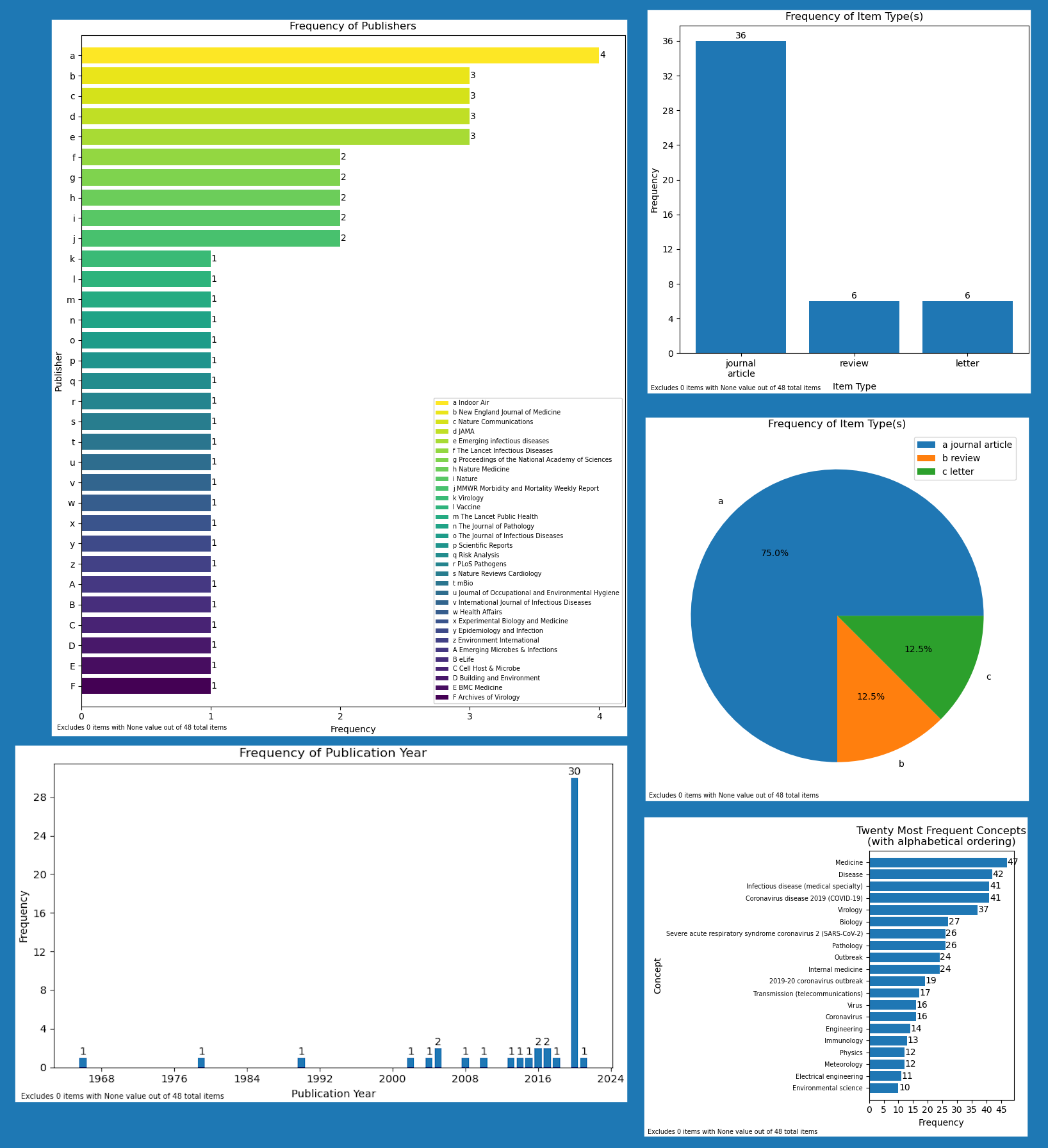

These visualizations give insight into the overall recency of the topic under investigation, as well as the wide variety of journals cited and disciplines represented. Overall, this exemplifies recent, still-fluctuating knowledge creation.
- Top left shows journal frequency
- Bottom left shows year distribution
- Top right and center right show publication type frequency
- Bottom right shows concept frequency
Limitations and notes for this example
This example does not include any publications without a DOI, which were cited at this conference, because those publications are un-queryable via OpenAlex. As previously noted, there are also time series implications for this conference. It took place in August 2020, so more recent publications are not included.